If you run marketing for a B2B company, someone has probably pitched you a new retainer this year with three or four new acronyms on it. AEO. GEO. LLMO. Each one promises to get you into ChatGPT, Perplexity or Google's AI Overviews.
Here's the honest version. Most of it is the same work as good SEO, done more carefully. A small part is genuinely new: making your facts consistent and easy to quote. And a few things being sold right now aren't worth paying for at all.
What is the difference between SEO, AEO, GEO and LLMO?
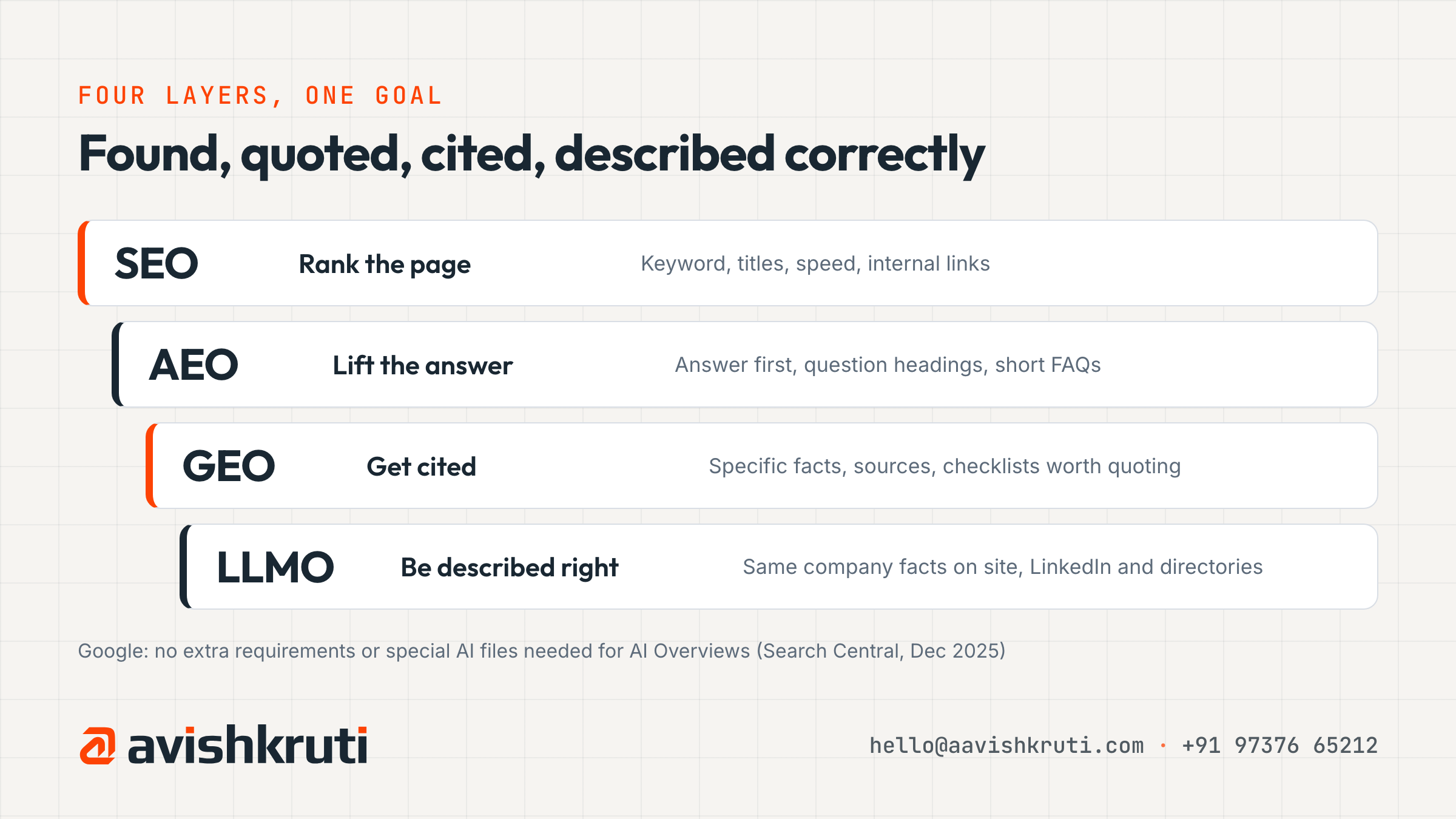
They're four layers of the same goal: being found and described correctly, whether the reader is a person, a search engine or an AI model.
SEO · Search Engine Optimization
The question it answers: Can Google and Bing find and rank this page?
What you actually do: One main keyword per page, clear titles, fast pages, internal links
AEO · Answer Engine Optimization
The question it answers: Can a search engine or voice assistant lift a direct answer from this page?
What you actually do: Answer first, question-shaped headings, short FAQ answers
GEO · Generative Engine Optimization
The question it answers: When ChatGPT, Perplexity, Gemini or Copilot writes an answer, will it quote and cite us accurately?
What you actually do: Specific, checkable facts with sources; checklists and data worth citing
LLMO · Large Language Model Optimization
The question it answers: Do AI models "know" our company correctly?
What you actually do: The same company facts on your site, LinkedIn, directories and press
Answer Engine Optimization (AEO) is the practice of structuring a page so a search engine or AI assistant can take a direct, accurate answer from it. GEO and LLMO extend the same idea to AI-written answers and to what models believe about your company.
Do I need anything special to appear in Google's AI Overviews?
No. Google says so plainly. Its guidance for site owners states there are "no additional requirements to appear in AI Overviews or AI Mode", and that you don't need new machine-readable files, AI text files or special markup (Google Search Central).
To be shown as a supporting link, a page has to be indexed and eligible to appear in normal Google Search with a snippet. In other words, if your SEO basics are broken, no AI-specific trick will fix it.
What actually changes on the page?
Five habits. None of them is a trick, and all of them also help human readers.
- Answer first. Put a 40–60-word direct answer near the top of the page, written so it makes sense if quoted on its own.
- Ask the questions your buyers ask. Make headings real questions ("How long does a HubSpot migration take?") and answer each in the first one or two sentences beneath it.
- Be specific and cite sources. Dates, numbers, steps and feature names, each linked to the vendor or regulator. AI tools prefer pages they can verify.
- Give them something worth quoting. A checklist, a comparison table, a worked example or your own data. Generic advice is everywhere. A clear 7-step checklist gets lifted.
- Make sure crawlers can read it. Check that robots.txt doesn't block search or AI crawlers you want, and that your main content is in the HTML, not loaded only by JavaScript after the page opens.
Why do consistent company facts matter so much?
Because AI models repeat what they find, including the mistakes.
If your About page says you were founded in one year and your timeline says another, or your homepage and your LinkedIn page give different team sizes, a model may pick either and state it confidently. This is the core of LLMO: one description of your company, word for word, everywhere. Your website, LinkedIn page, Google Business Profile, Clutch and partner directories should all agree on what you do, where you are, when you started and who you serve.
It's unglamorous work. It's also the change with the biggest effect on what AI tools say about you.
What should you not pay for?
- "FAQ schema for rich snippets." Google stopped showing FAQ rich results in Search on 7 May 2026 (Google). A visible FAQ section is still worth having for readers and answer engines, and the markup is harmless, but it no longer earns you a special result in Google.
- An llms.txt retainer. llms.txt is a proposal, first published in 2024, for a plain-text file that summarises your site for AI agents (llmstxt.org). It's cheap to add and some AI tools read it. Google says it doesn't need one. It's an afternoon's work, not a monthly fee.
- Guaranteed AI rankings. Nobody controls what ChatGPT or Gemini says, and answers change between runs. Anyone guaranteeing a mention is guessing.
- Hidden text or "instructions to AI" in your pages. Hidden text and keyword stuffing break Google's spam policies and can get pages demoted. They're also a brand risk if anyone notices.
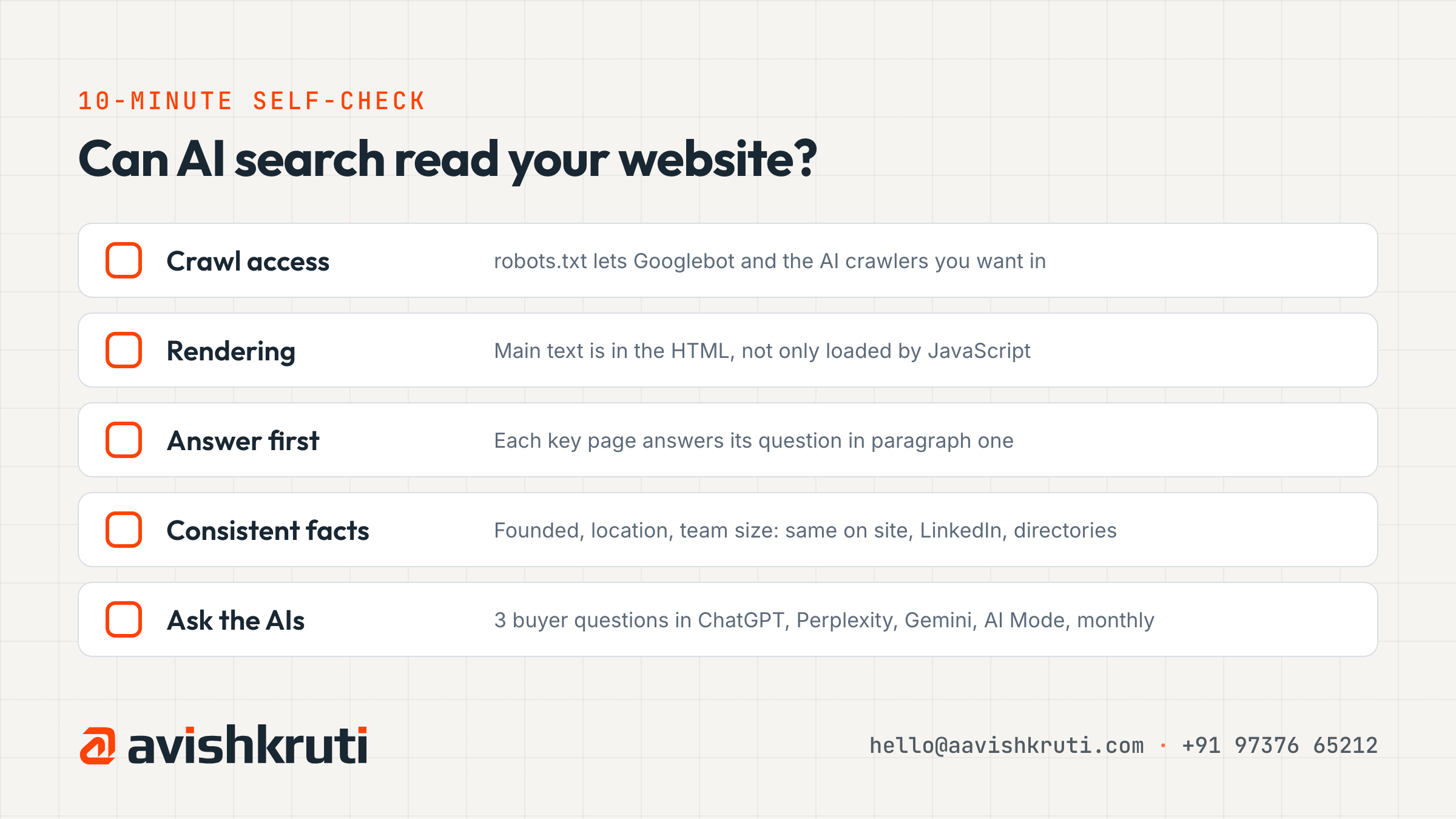
Your 10-minute self-check
- Open
yourdomain.com/robots.txt. Are Googlebot and the AI crawlers you care about allowed? - View the source of a key service page. Is the main text in the HTML?
- Does each key page answer its main question in the first paragraph?
- Are your founding year, location, team size and services the same on your site, LinkedIn and directories?
- Ask ChatGPT, Perplexity, Gemini and Google AI Mode the same three questions a buyer would ask about your service. Note who gets mentioned and which pages get cited. Repeat monthly and track the direction, not single results.
How we do it on this blog
You're reading the worked example. Every post here starts with a Quick answer in the sidebar, uses question-shaped headings, cites primary sources, ends with a short FAQ marked up as FAQPage, and closes with the same one-line company description. We build the same habits into the HubSpot CMS and WordPress sites we deliver, because we build for the content team, not just developers.
Frequently asked questions
Is AEO different from SEO?
Only slightly. AEO is SEO with extra focus on giving direct, quotable answers: answer-first paragraphs, question-shaped headings and FAQ sections. The technical basics are the same.
Do I need an llms.txt file?
You don't need one for Google. Google says no special AI files are required for AI Overviews. llms.txt is a cheap, optional extra that some AI tools read, so it's fine to add one, but don't pay a retainer for it.
Does FAQ schema still work in 2026?
Not for Google rich results, which stopped appearing on 7 May 2026. FAQ sections still help readers and answer engines, and the markup does no harm.
How do I get my company mentioned by ChatGPT or Perplexity?
Publish specific, sourced content worth citing, keep your company facts identical everywhere, and get listed on trusted third-party sites. No one can guarantee a mention.
Want to know how AI search sees your website? We'll run the 10-minute check on your site and send back what we found, with fixes in priority order. Talk to our web team →
Aavishkruti Solutions is a HubSpot Solutions Provider and software engineering company founded in 2021 in Ahmedabad, India, serving clients mainly in the US, UK and Australia.