If you costed an AI automation last year and parked it because the running cost didn't add up, the numbers have changed. Between 22 September and 7 October 2026, Anthropic and OpenAI both cut their API prices, some by half.
That doesn't mean every AI idea is now a good idea. It means the excuse has moved. For most small-company automations, the model bill is no longer the expensive part. Here's what changed, what real workloads cost now, and what we'd re-price this month.
What changed in AI API pricing in September and October 2026?
Three model families got cheaper within three weeks, and the cheap tier got far more capable.
API pricing is quoted per million tokens. A token is a chunk of text, roughly three-quarters of an English word. You pay one rate for what you send in (input) and a higher rate for what the model writes back (output).
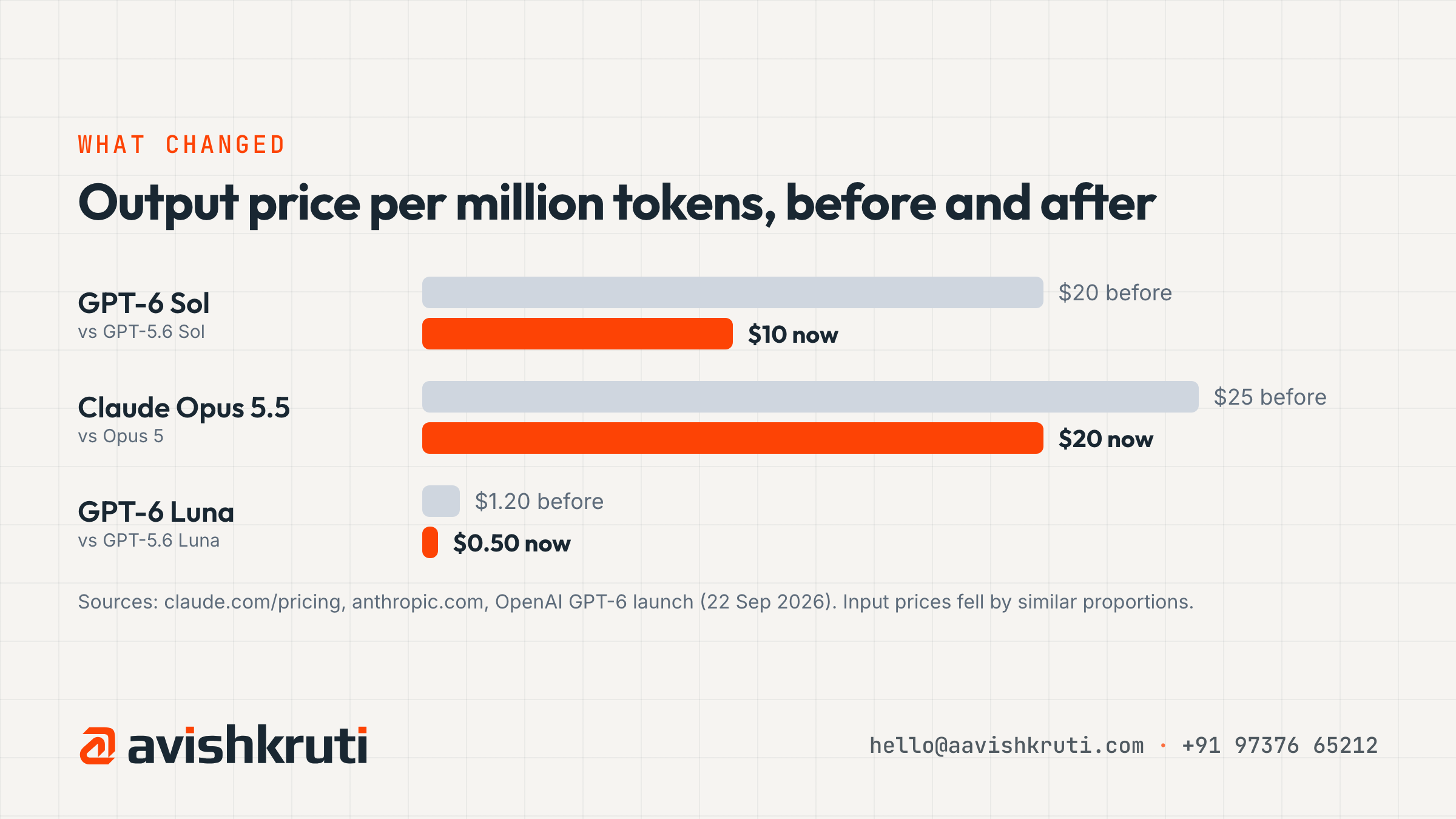
GPT-6 Sol (OpenAI) · released 22 Sep
Price (input / output per 1M tokens): $2 / $10
Compared with: GPT-5.6 Sol at $4 / $20
GPT-6 Luna (OpenAI) · released 22 Sep
Price (input / output per 1M tokens): $0.10 / $0.50
Compared with: GPT-5.6 Luna at $0.20 / $1.20
Claude Opus 5.5 (Anthropic) · released 22 Sep
Price (input / output per 1M tokens): $4 / $20
Compared with: Opus 5 at $5 / $25
Claude Sonnet 5.5 (Anthropic) · released 28 Sep
Price (input / output per 1M tokens): $2 / $10
Compared with: "Up to 30% less" to run, per Anthropic
Claude Haiku 5.5 (Anthropic) · released 7 Oct
Price (input / output per 1M tokens): $0.10 / $0.50 (prompts up to 100K tokens)
Compared with: Priced 90% lower than Haiku 4.5 for prompts up to 100K tokens, per Anthropic
Sources: Anthropic pricing, Claude Opus 5.5, Claude Haiku 5.5, and OpenAI's GPT-6 Sol and Luna launch as reported by The Next Web. Prices checked 16 October 2026.
Two details matter more than the headline prices:
- Anthropic says Opus 5.5 costs about 40% less than Opus 5 on typical workloads, not just 20%. It uses fewer tokens per task, and the per-token price is lower.
- Google's Gemini 4 Argon (30 September) launched at an introductory $2 / $10, rising later to $4 / $20. At launch it was limited to trusted testers, with paid API access "rolling out soon", so check availability before you plan a project on it (9to5Google).
How much does AI automation cost to run now?
For a typical back-office workflow, the model cost is now between a few dollars and a few hundred dollars a month. Here are two worked examples. The volumes are illustrative, but the arithmetic is the real price list.
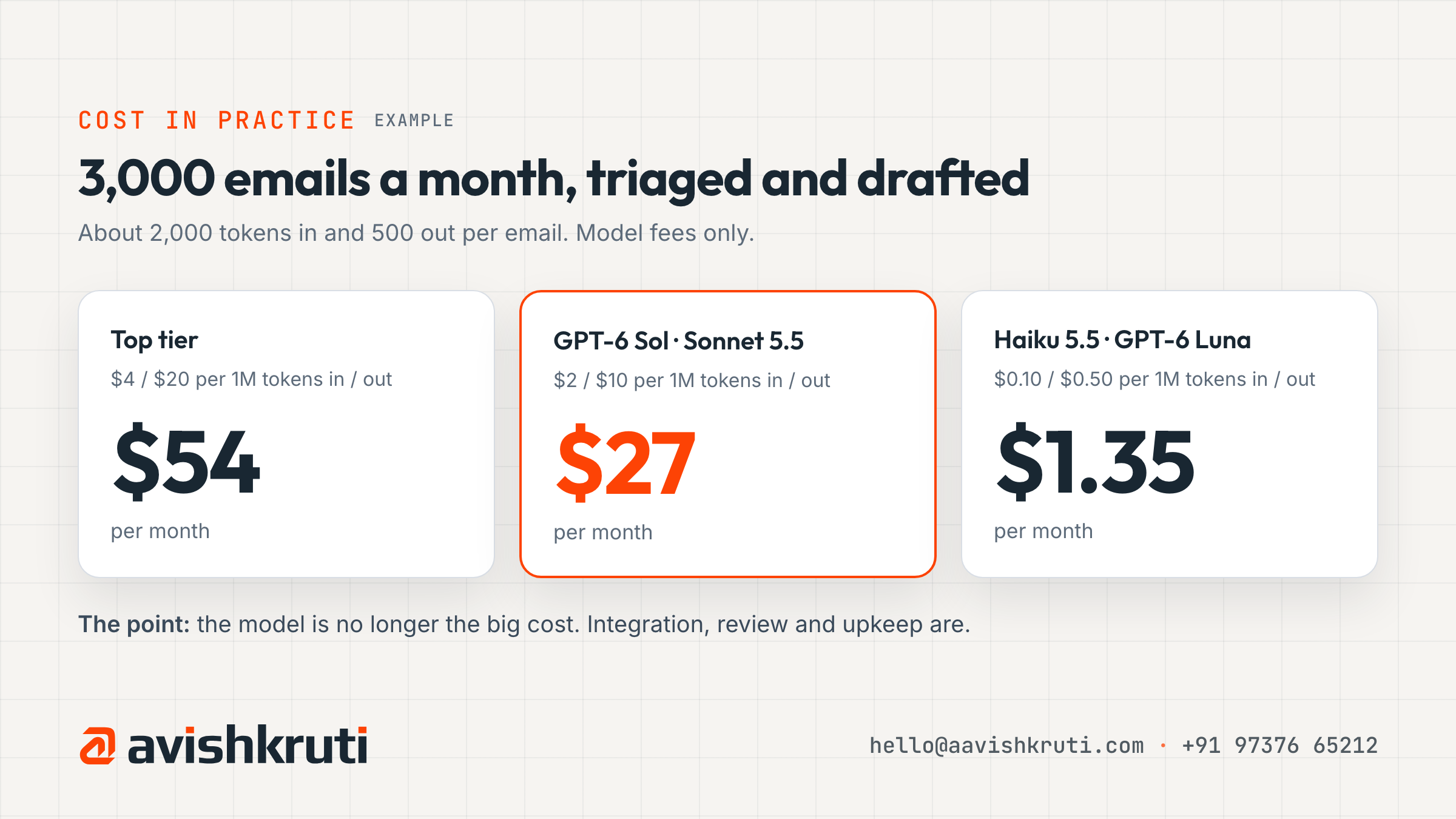
Example 1: triage and draft replies to 3,000 inbound emails a month. Each email plus context is about 2,000 tokens in, and the drafted reply about 500 tokens out.
- On a top-tier model at $4 / $20: about $54 a month
- On GPT-6 Sol or Claude Sonnet 5.5 at $2 / $10: about $27 a month
- On Claude Haiku 5.5 or GPT-6 Luna at $0.10 / $0.50: about $1.35 a month
Example 2: an AI agent that works through a multi-step task 1,000 times a month. Agents make many model calls per task. Say 30 calls, each sending 8,000 tokens of context and getting 800 back.
- At Opus 5's old $5 / $25: about $1,800 a month
- At Opus 5.5's $4 / $20: about $1,440 a month
- At $2 / $10: about $720 a month
The first example shows why simple automations were never really blocked by model price. The second shows where the cuts matter. Agents multiply token use, so these cuts can turn a "maybe" into a "yes" for agentic workflows.
Two levers cut these numbers further. Prompt caching charges far less for context you resend on every call: Opus 5.5 cache reads cost $0.20 per million tokens against $4 for normal input. Batch processing saves 50% on Anthropic's API for work that doesn't need an instant answer, like overnight document runs.
Why the model bill is no longer the real cost
Once the model costs $27 a month, the money is somewhere else:
- Integration. Getting data out of your CRM, ERP, inbox or helpdesk and writing results back safely. This is usually most of the build.
- The review step. Someone has to check outputs until you trust them, and keep checking samples after that.
- Exceptions. The 10% of cases the automation can't handle need a clean hand-off to a person.
- Maintenance. Models get replaced every few months. Prices moved twice in three weeks. Your prompts, tests and integrations need upkeep.
So the right question isn't "how much is the model?" It's "what does one finished task cost, including the person who checks it, compared with doing it by hand?"
What should you re-price this month?
Look again at work you rejected on running cost, especially high-volume jobs:
- Every inbound document, not a sample: supplier invoices, purchase orders, delivery notes, CVs
- Every call or meeting transcript summarised into the CRM with next steps
- Product data at catalogue scale: titles, attributes and descriptions for thousands of SKUs (useful for AI shopping agents this BFCM)
- First-line support triage, with drafted replies for a person to approve
- Multi-step agent workflows that were too expensive at 30+ calls a task
And build it so the next price change helps you rather than locks you in:
- Route by difficulty. Send routine work to a small model and the hard 10–20% to a bigger one.
- Stay provider-agnostic. Keep one thin layer between your app and the model API so switching vendors is a config change, not a rebuild.
- Measure cost per finished task, not cost per token.
- Keep a human approval step for anything that sends money, emails customers or changes records.
Frequently asked questions
How much does Claude Opus 5.5 cost?
$4 per million input tokens and $20 per million output tokens, down from $5 and $25 for Opus 5. Anthropic says it costs about 40% less than Opus 5 on typical workloads.
How much do GPT-6 Sol and GPT-6 Luna cost?
GPT-6 Sol is $2 per million input tokens and $10 per million output tokens. GPT-6 Luna is $0.10 and $0.50. GPT-6 Sol is half the price of GPT-5.6 Sol. GPT-6 Luna halves the input price and cuts output by about 58%.
What is the cheapest capable AI model in October 2026?
Claude Haiku 5.5 and GPT-6 Luna both cost $0.10 per million input tokens and $0.50 per million output tokens. They suit high-volume jobs like classification, extraction and summaries, but they're weaker than larger models on complex multi-step work.
Should I wait for AI prices to fall further before automating?
No. Model cost is now a small part of most automations. The integration, review step and maintenance cost the same whenever you start. Build provider-agnostic, and future price cuts lower your bill automatically.
How we approach it at Aavishkruti
We build AI automations the same way we build integrations: connected to the systems you already run, with a human approval step where it matters and no lock-in to one model vendor. We start with the job and the cost per finished task, not the model, and we'll tell you when a simple rule or a spreadsheet beats an AI agent.
Parked an AI pilot because of running costs? Send us the use case and we'll re-price it at October 2026 rates, with an honest yes or no. Talk to our AI & automation team →