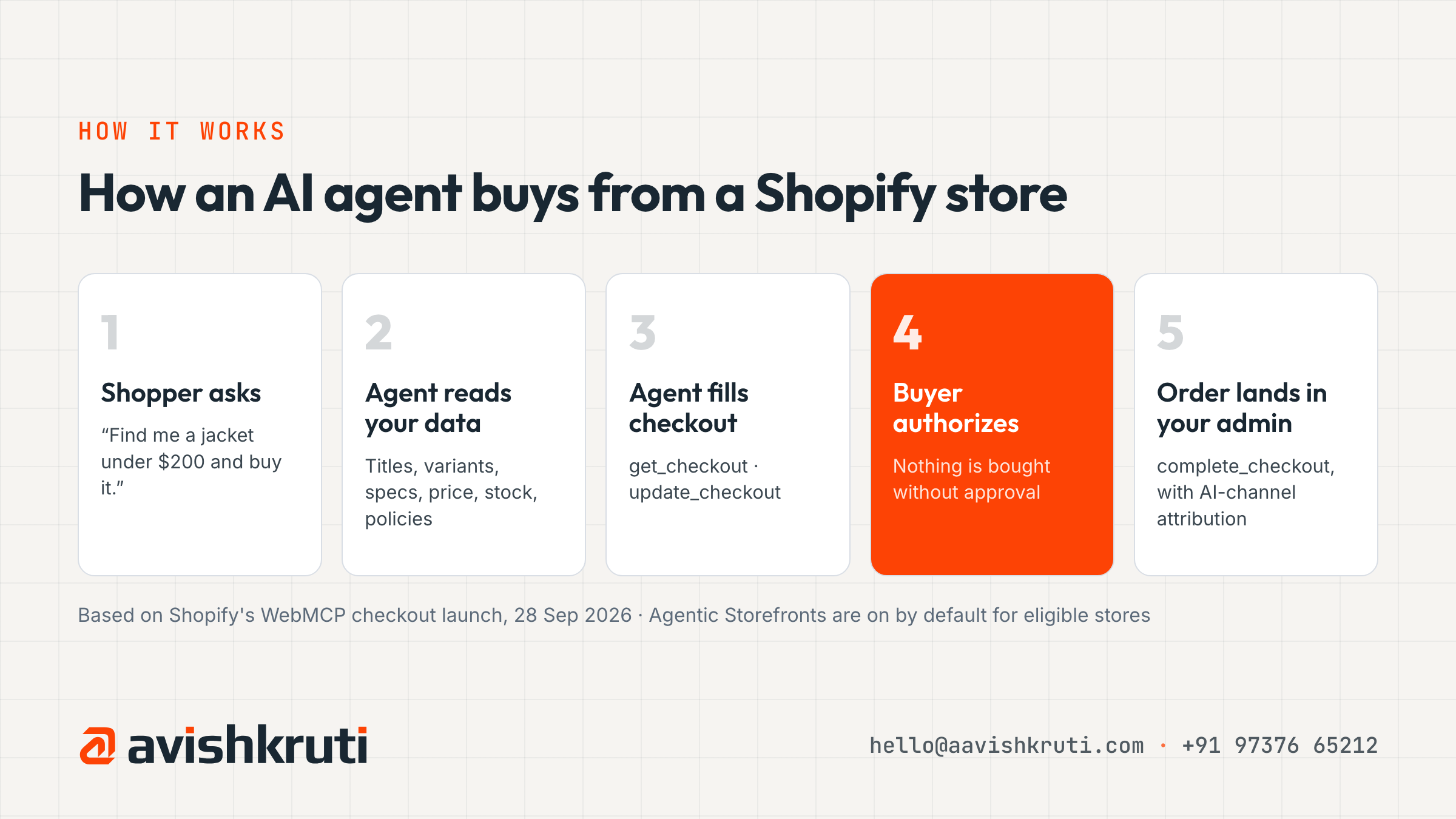
On 28 September, Shopify switched on something that will quietly change this year's holiday season. AI agents running in a shopper's browser can now complete checkout on Shopify stores, Shop Pay included, with the buyer's authorization.
Black Friday is 27 November and Cyber Monday is 30 November. That leaves about seven weeks to make sure that when a shopper says "find me a waterproof hiking jacket under $200 and buy it", the agent can find your product, understand it and buy it.
What changed: can AI agents really buy from Shopify stores?
Yes. Agentic commerce is shopping where an AI assistant finds, compares and buys products on a person's behalf. On Shopify it now covers the whole journey, from discovery to payment. It arrived in two steps, a few months apart:
1. Your products are already in AI shopping channels. Shopify's Agentic Storefronts are "active by default for eligible stores". Products can surface in ChatGPT, Microsoft Copilot, Google's AI Mode, the Gemini app and Perplexity, and the orders land in your normal Shopify admin.
2. Agents can now finish the purchase. Shopify added WebMCP support to checkout. WebMCP is a proposed standard that gives in-browser agents structured tools (get_checkout, update_checkout, complete_checkout) so they don't have to scrape your page or click through it by guessing. The agent reads the checkout, updates the address or delivery option, and places the order once the buyer approves.
Shopify's own numbers show this isn't a niche. In Q2 2026, AI-driven traffic to Shopify stores grew 197% year over year, and orders from AI-powered searches tripled. Shopify also says 75% of AI-attributed orders came from categories outside the top 100 by sales volume, so long-tail products benefit most.
Why does this matter for your store?
An AI agent doesn't see your hero banner, your brand video or your clever headline. It reads structured data: titles, variants, specs, prices, stock, shipping rules and return policies. If that data is thin, vague or inconsistent, the agent recommends a competitor whose data is clean.
The risk is invisible, which makes it worse. You won't see an error when an agent skips your store. You'll just see flat numbers on the biggest weekend of the year.
How do you prepare a Shopify store for AI shopping agents? The 7-point checklist
1. Rewrite product titles for machines and humans
"The Explorer" tells an agent nothing. "Men's Waterproof Hiking Jacket – 3-Layer Gore-Tex – Navy" tells it everything. Name the material, size range, use case and audience. Shopify's own guidance is to use factual specifications, not subjective marketing language.
2. Fill every standard product field
Product category, product type, vendor, variant options (size, colour, material), weight and GTIN/barcode where you have them. Empty fields make it harder for an agent to match a product to a specific request.
3. Fix variant chaos
Variants named "Option 1 / Default Title", or sizes entered as "S", "Small" and "sm" across different products, confuse agents. Standardise option names and values across the catalogue.
4. Publish shipping and returns in plain language
Agents answer "will it arrive before 2 December?" and "can I return it?" before they buy. Put your shipping times, cut-off dates, regions and return window on dedicated policy pages in plain sentences. Add holiday cut-offs now.
5. Put real reviews and FAQs on product pages
Shopify specifically calls these out. A product with 40 reviews and five clear FAQs ("Is it machine washable?") gives an agent more to reason with than one with none.
6. Check your purchase tracking. This one is urgent.
This is separate from AI agents but just as important for BFCM. 26 August 2026 was the deadline for non-Plus stores to upgrade their Thank you and Order status pages. Upgrading replaces the old pages and their customisations, and the legacy "additional scripts" field has been view-only since August 2025.
If your Meta, Google or TikTok purchase events lived in those old scripts and weren't rebuilt as web pixels or app pixels, your ad platforms may not be seeing purchases. Place a test order today and confirm it shows up in every ad platform and in GA4. Black Friday is a bad weekend to find out your ROAS numbers are wrong.
7. Watch the new channel in your reports
AI-channel orders show up in your Shopify admin with attribution. Set up a simple weekly view now so you have a baseline before November, and so you can tell whether the work above is moving anything.
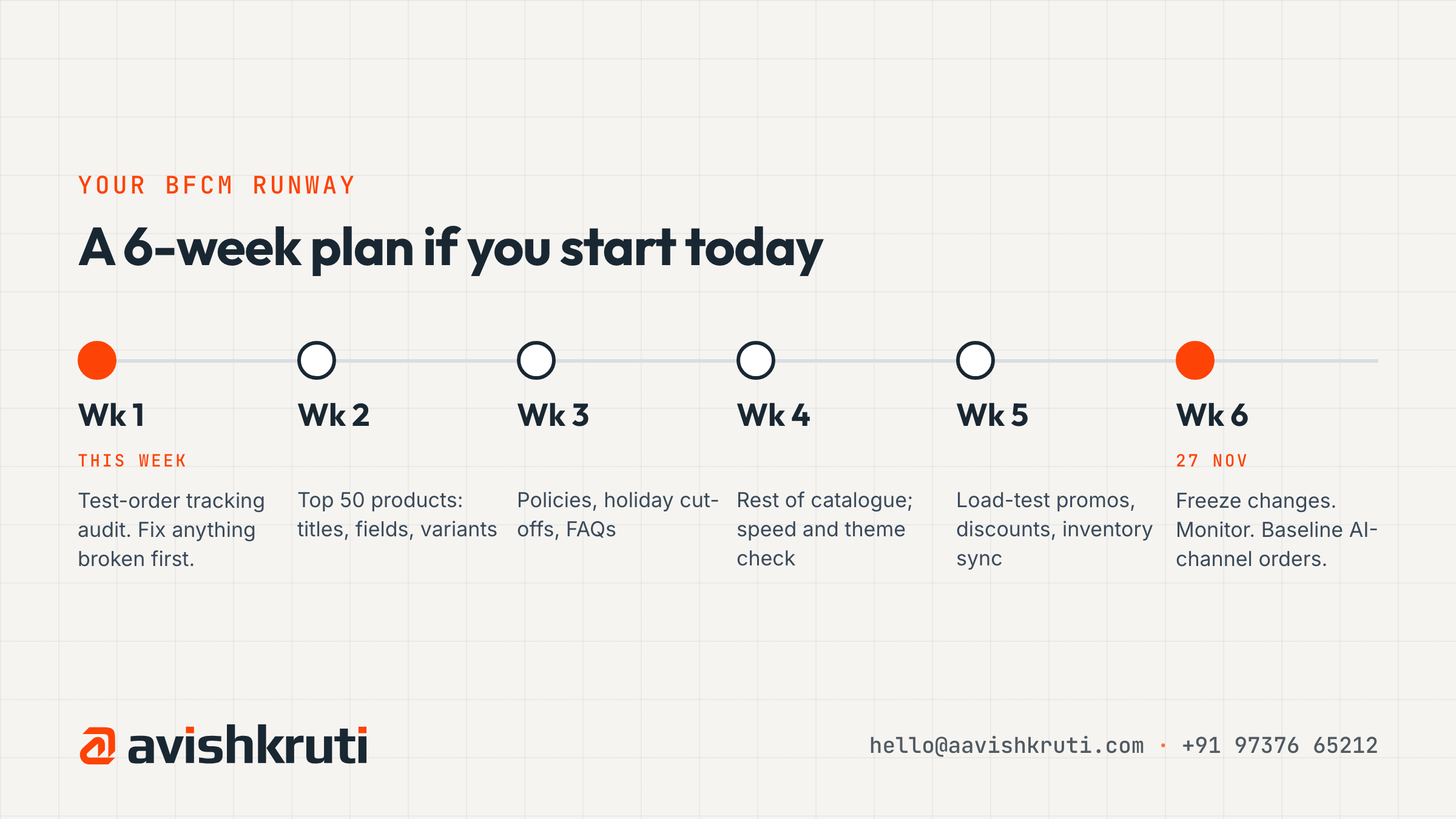
A 6-week plan if you're starting today
| Week | Focus |
|---|---|
| 1 (this week) | Test-order tracking audit (item 6). Fix anything broken first. |
| 2 | Top 50 products: titles, fields, variants (items 1–3) |
| 3 | Policies, holiday shipping cut-offs, FAQs (items 4–5) |
| 4 | Remaining catalogue; site speed and theme check |
| 5 | Load-test promos, discount logic and inventory sync |
| 6 | Freeze changes. Monitor. Baseline AI-channel reporting (item 7). |
Frequently asked questions
Can AI agents buy from my Shopify store without the customer knowing?
No. Under Shopify's WebMCP checkout support, the agent can read and fill in the checkout, but it places the order only with the buyer's authorization.
What is WebMCP?
WebMCP is a proposed standard that gives AI agents in a shopper's browser structured tools for a website, so they don't have to scrape pages. On Shopify checkout the tools are get_checkout, update_checkout and complete_checkout.
Do I need to install anything to appear in ChatGPT or Perplexity shopping?
No. Shopify says Agentic Storefronts are active by default for eligible stores. The work is in your product data, not in an app.
Why might my Black Friday ad numbers be wrong?
Non-Plus stores had to upgrade their Thank you and Order status pages by 26 August 2026. Tracking that lived in the old "additional scripts" field must be rebuilt as web or app pixels, or purchases may not reach your ad platforms. Place a test order to check.
How we approach it
When we work on Shopify stores, we treat product data as infrastructure, not copywriting. The same clean catalogue that helps an AI agent also feeds your Google Shopping feed, your on-site search and your marketplace listings. Fix it once and it pays off across every channel.
Want a second pair of eyes before BFCM? We'll review your top products and your checkout tracking and send back a prioritised fix list. Talk to our Shopify team →
Aavishkruti Solutions is a HubSpot Solutions Provider and software engineering company founded in 2021 in Ahmedabad, India, serving clients mainly in the US, UK and Australia.